
“Grandma, It’s Me”: The Call That Sounded Like Family
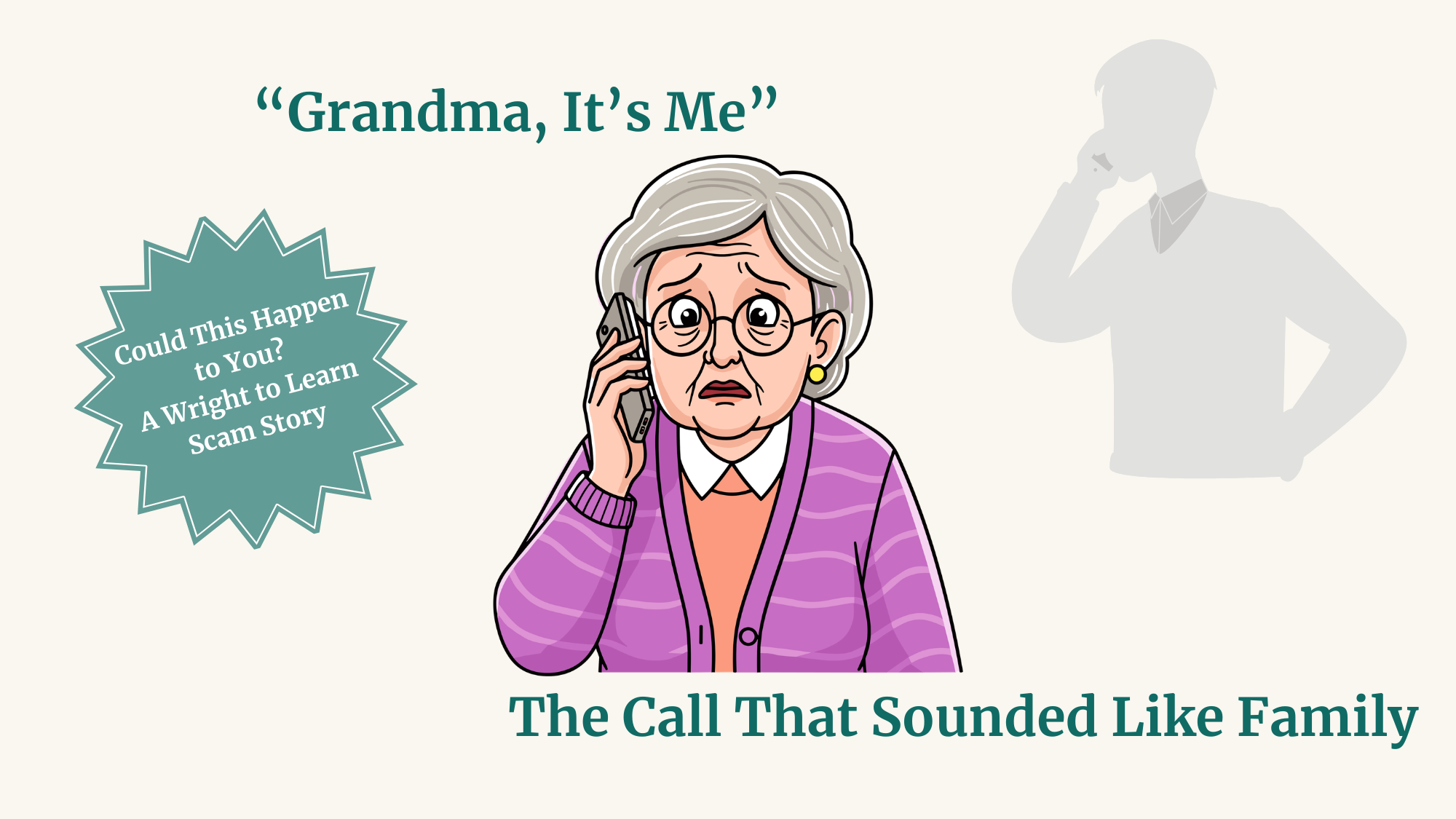
Could This Happen to You? A Wright to Learn Scam Story
The people in this story are fictional, but the scam tactics are based on real scams reported to consumer protection agencies.
When Marilyn's phone rang that afternoon, she didn't recognize the number. She almost let it go to voicemail, but decided to answer.
"Grandma?"
It was Evan. She recognized her grandson's voice immediately, although he sounded upset.
"Evan? What's wrong?"
"Grandma, I need your help."
Evan told her he'd been in a car accident. He wasn't seriously hurt, but he'd been arrested afterward and needed money for bail. He explained that he was calling from jail, which was why the number wasn't his usual one. He'd only been allowed a brief phone call, and he'd chosen to call her.
Marilyn was frightened. Evan lived several states away, and she hadn't spoken to him in a couple of weeks. She pictured him sitting alone somewhere, scared and embarrassed.
Then he asked her not to tell his parents. They'd be furious, he explained, and he wanted to straighten things out before they found out. Marilyn understood. Evan was 22, and she remembered what it was like to be that age.
Before she could ask much more, Evan told her an attorney was there and could explain what needed to happen next.
"I'm Helping Your Grandson"
The man who came on the line sounded calm and professional. He introduced himself as Evan's attorney and explained that Evan could be released that afternoon, but bail needed to be paid first.
The amount was $7,500.
Marilyn had the money in savings, but it was a lot to send without warning. The attorney seemed to anticipate her hesitation. He explained that time was running out and that the payment needed to be made through a money-transfer app rather than by check or credit card. He could walk her through the process over the phone.
Marilyn wasn't familiar with paying bail that way, but the attorney sounded confident, and her priority was getting Evan home.
Still, she wanted to speak with her grandson again before agreeing to anything.
When Evan returned to the phone, his voice sounded as familiar as ever. "I'm so sorry, Grandma."
Marilyn wanted to help him, but something about the situation bothered her. The unfamiliar number had an explanation, and she didn't know enough about the legal system to question the attorney's payment instructions. Yet she couldn't shake the feeling that she should check something before sending the money.
"Do you remember what you gave me for my birthday last year?"
There was a pause. Then Evan's voice returned, sounding frustrated. "Grandma, I really don't have time for this right now."
Marilyn told him she understood, but she wanted him to answer the question anyway.
The call disconnected.
A Different Kind of Phone Call
Marilyn stared at her phone for a moment before calling her daughter. Was Evan okay?
Her daughter was confused. As far as she knew, he was fine.
After Marilyn explained what had happened, they called Evan on his usual number. He was at work. There had been no accident, no arrest, and no attorney.
Relief quickly gave way to anger and embarrassment.
"I almost sent them the money," Marilyn admitted. "But it sounded exactly like him."
Her daughter didn't laugh or question how she could have believed it. Instead, she mentioned something she'd heard about: scammers using artificial intelligence to imitate people's voices.
Neither of them could know for certain how the caller had sounded so much like Evan, but the possibility of AI voice cloning was unsettling.
The scammer hadn't needed Marilyn to be careless. He needed her to believe that someone she loved was in trouble—and that she could help.
Let's Break It Down
Family impersonation scams, sometimes called "grandparent scams," use our concern for loved ones to create a sense of urgency. A caller might claim to have been arrested, hospitalized, or stranded somewhere and insist that money is needed immediately.
Here's how the scammers tried to convince Marilyn.
A familiar voice isn't proof of identity
In this story, the caller sounded remarkably like Evan. AI voice-cloning technology can imitate someone's voice using audio recordings, including material that may be available through social media.
Not every family impersonation scam involves AI. Some callers simply say "It's me" and let the person answering supply a name. Others explain an unfamiliar voice by claiming to be sick, injured, or calling through a bad connection.
But the lesson is the same: even a voice that sounds exactly like someone you know isn't enough to confirm their identity.
The unfamiliar number had an explanation
The caller said he was calling from jail, which explained why Evan's usual number didn't appear on Marilyn's phone.
Scammers often have ready-made explanations for details that might otherwise raise questions. And because caller ID can be spoofed, even a familiar number isn't a guarantee that the person calling is who they claim to be.
Urgency and secrecy kept the pressure on
Marilyn was told Evan could be released that afternoon, but only if she acted quickly. He also asked her not to tell his parents.
Both details served a purpose. The deadline discouraged her from taking time to investigate, while the request for secrecy discouraged her from contacting people who might recognize the scam.
The "attorney" added authority
The second caller sounded professional and seemed to know exactly what needed to happen. His calm manner made the situation feel more legitimate, especially compared with Evan's distress.
But sounding official isn't the same as being trustworthy.
The payment method was another warning sign
The attorney instructed Marilyn to send $7,500 through a money-transfer app.
Scammers frequently request payment through gift cards, cryptocurrency, wire transfers, or payment apps such as Zelle or Venmo because recovering the money can be difficult.
These are legitimate ways to make payments in many situations. But an unexpected demand for a large payment through one of these methods, especially under pressure, is a strong reason to stop and verify.
What to Do If You Get a Call Like This
You don't have to decide whether the caller is telling the truth while you're still on the phone.
Hang up and verify the emergency independently. Call your family member using a number you already have saved. If you can't reach them, contact another relative or someone else who may know where they are.
You can also ask a question that a stranger would be unlikely to answer correctly. Avoid relying on details that might be available through social media, and remember that even a correct answer isn't foolproof.
Some families agree on a private verification word or phrase to use in emergencies. It's one more way to check someone's identity, provided the phrase isn't shared publicly.
Most importantly, don't let a caller's urgency or request for secrecy prevent you from checking with someone else.
What to Do If You Already Sent Money or Shared Information
If you've sent money, contact the bank, payment app, or other company you used as soon as possible. Explain that the transaction was connected to a scam and ask whether it can be stopped or reversed. Your options will depend on how the money was sent.
If you shared passwords or account information, change your passwords through the legitimate website or app and take steps to secure your accounts.
You can report the scam to the Federal Trade Commission at ReportFraud.ftc.gov. If you shared sensitive personal information, IdentityTheft.gov offers guidance on protecting yourself.
And consider telling your family what happened. Sharing the experience may help prevent someone else from being targeted.
Bottom Line
Marilyn didn't need to understand AI voice cloning or recognize every detail of a family impersonation scam to protect herself.
She needed to interrupt the story the caller was telling.
By asking a question and then contacting her family independently, she stopped relying on the information the scammer provided and checked it against reality.
When an unexpected call creates a crisis and demands immediate action, verify that the crisis is real before responding.
Digital Resilience Takeaway
The skill: Verify through a second channel.
Why it matters: Voices, phone numbers, and personal details can all be convincing without being trustworthy. Independent verification helps you make decisions based on information the caller doesn't control.
Try this: Talk with your family about how you would verify an emergency. Agree on a trusted number to call, another person to contact, or a private verification phrase.
Having a plan ahead of time makes it easier to use when emotions are running high.
Continue Building Your Digital Resilience
Wright to Learn's digital safety and privacy classes provide practical, judgment-free opportunities to explore common scams and build habits that can help you navigate unexpected calls, texts, emails, and websites with greater confidence.
Learn practical ways to verify unexpected messages and protect yourself from impersonation scams. Find an upcoming class by clicking the button below.
